Planning a tattoo or beauty treatment and curious about breastfeeding safety?
It’s common to have questions about how tattoos, piercings, or beauty treatments might impact breastfeeding. There isn’t a lot of research on many of these topics but here’s what we know to help you make informed choices.
Tattoos
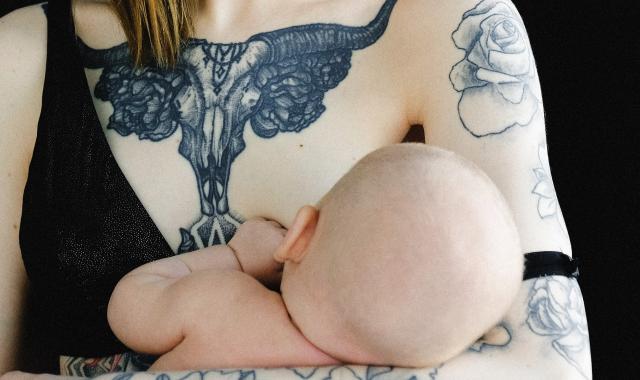
There isn’t much research about the safety of getting a new tattoo while breastfeeding. Most experts recommend waiting until after you’ve finished breastfeeding before getting a new tattoo.1 That said, no negative effects on babies have been reported when a breastfeeding mother gets a tattoo.2
- The risk of infection passing to your baby through breastmilk is very low, especially if you choose a registered tattoo studio with strict hygiene practices.3
- Tattoo ink molecules are large and unlikely to pass into breastmilk. However, some inks contain tiny nanoparticles, and we don’t yet know their effects.4
- Human milk banks usually won’t accept milk donations for 6 months after a new tattoo, piercing, or permanent makeup.5
- If you’re thinking about tattoo removal, keep in mind that the process breaks up ink particles, and the effects on breastmilk are unknown. Many experts suggest waiting until after weaning to start tattoo removal.6
In Australia, tattoo parlours have to be registered with the local council and each state has laws about infection control within the body art industry. The Victorian Government Department of Health (Better Health Channel, 2020) advises people who want to get a tattoo to choose a place that is registered with the local council and has a good reputation.
Piercings
Body piercings, especially nipple piercings, can raise questions for women, even if they’re not breastfeeding at the time. Find more details in our dedicated article.
Hair treatments
Hair colouring, curling, bleaching, and straightening are unlikely to affect your breastmilk. Only a tiny amount of chemicals, if any, would reach your milk.7
Hair removal creams are not well absorbed into the bloodstream, so they’re very unlikely to end up in your breastmilk. There’s no evidence that electrolysis or laser hair removal affects breastfeeding or your baby.8
Losing hair
It’s common to lose some hair after having a baby. This isn’t caused by breastfeeding. Most women find their hair returns to normal within 6–12 months after birth. If you’re concerned, or if hair loss continues after 12 months, see your doctor.8
Nail treatments
There isn’t much research on nail treatments and breastfeeding, but we do know that nail products like polish, removers and gels can release chemicals in their fumes. Home nail treatments and occasional salon visits are fine. The main concern is for people working in salons with regular exposure to strong fumes can be risky without good ventilation and protective measures.
Fake tans
The active ingredient in self-tanning lotions (DHA) stains the skin but isn’t known to affect breastmilk.
There are no studies on DHA in breastmilk, but if you use a self-tanner, avoid applying it to areas your baby’s mouth will touch (like your nipple and areola).8
Cosmetic procedures and products
There isn’t a lot of research on cosmetic procedures and breastfeeding.9,10 Studies listed in the references list below may provide reassurance.
- Botox: The risk of problems from Botox while breastfeeding appears to be very low. When issues do happen, they’re usually related to how the treatment is given rather than the Botox itself.9
- Chemical and liquid exfoliant peels and dermal fillers: These peels are generally considered safe while breastfeeding, as long as you don’t have mastitis or another ongoing infection. They’re not recommended during pregnancy.9
- Parabens: These are preservatives and fragrances used in many skin care, hair care and makeup products. Studies have observed parabens in samples of the breastmilk of mums with newborns. While levels are very low there is a growing public health concern about human exposure to parabens. It may be helpful to limit your use of personal care items that contain parabens.11
If you’re unsure, speak to a reputable clinic or call a medicines information line to find out more about the medications or chemicals used.
© Australian Breastfeeding Association May 2026
MotherSafe. (2021). Skin care, hair care and cosmetic treatments in pregnancy and breastfeeding. NSW Health. skinhairpregbr2021.pdf (nsw.gov.au)
References
- Roche-Paull, R. (2015). Body modifications and breastfeeding: What you need to know. Journal of Human Lactation, 31(3), 552–553. https://doi.org/10.1177/0890334415584597
- National Institute of Child Health and Human Development. (2021). Tattooing. Drugs and Lactation Database (LactMed®). https://www.ncbi.nlm.nih.gov/books/NBK500563/
- Kluger N. (2015). Contraindications for tattooing. Current Problems in Dermatology, 48, 76–87. https://doi.org/10.1159/000369189
- Farley, C. L., Van Hoover, C., & Rademeyer, C. A. (2019). Women and tattoos: Fashion, meaning, and implications for health. Journal of Midwifery & Women's Health, 64(2), 154–169. https://doi.org/10.1111/jmwh.12932
- Mother’s Milk Bank Charity. (2023). Donating milk FAQs.
- Kluger, N., & De Cuyper, C. (2018). A practical guide about tattooing in patients with chronic skin disorders and other medical conditions. American Journal of Clinical Dermatology, 19(2), 167–180. https://doi.org/10.1007/s40257-017-0326-5
- Butler, D. C., Heller, M. M., & Murase, J. E. (2014). Safety of dermatologic medications in pregnancy and lactation: Part II. Lactation. Journal of the American Academy of Dermatology, 70(3), 417.e1–427. https://doi.org/10.1016/j.jaad.2023.10.072
- MotherSafe. (2021). Skin care, hair care and cosmetic treatments in pregnancy and breastfeeding. NSW Health.
- Trivedi, M. K., Kroumpouzos, G., & Murase, J. E. (2017). A review of the safety of cosmetic procedures during pregnancy and lactation. International Journal of Women's Dermatology, 3(1), 6–10. https://doi.org/10.1016/j.ijwd.2017.01.005
- Cox, S. E., & Adigun, C. G. (2011). Complications of injectable fillers and neurotoxins. Dermatologic Therapy, 24(6), 524–536. https://doi.org/10.1111/j.1529-8019.2012.01455.x
- Park, N.-Y., Cho, Y. H., Choi, K., Lee, E.-H., Kim, Y. J., Kim, J. H., & Kho, Y. (2019). Parabens in breast milk and possible sources of exposure among lactating women in Korea. Environmental Pollution, 255(Pt 2), 113142. https://doi.org/10.1016/j.envpol.2019.113142