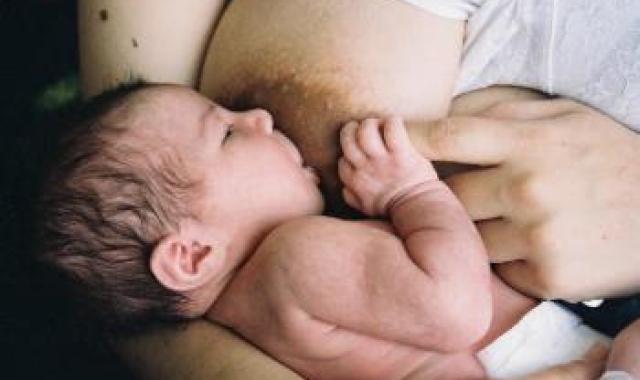
White spots on the nipple can be sore, but gentle care can help you keep breastfeeding.
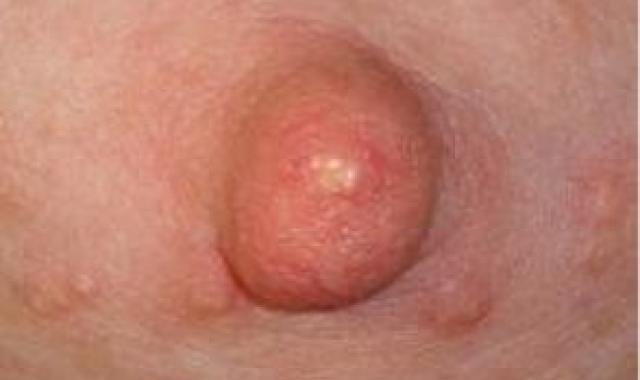
A white spot on the nipple is usually tiny – about the size of a pinhead or a little bigger. It doesn’t always look white. It might be pink or light yellow, and the skin around it can look red and inflamed.
Some white spots look like a blister and may appear larger after a feed. Others seem to be firm and scar-like. You might hear them called a bleb, a milk blister or a blocked nipple pore.
White spots can appear at any stage of breastfeeding and may come and go. They often feel sore during a feed, and sometimes the pain makes it hard to breastfeed.
What causes the white spot?
Not a lot is known about white spots but they are often associated with breast inflammation or repeated nipple damage. Scientists think spots form when the opening of a duct carrying breastmilk to the nipple becomes inflamed and closes. This stops milk from flowing.
Gentle ways to manage a white spot
Because we don't yet know the best way to treat white spots, gentle care is recommended. If the spot isn’t causing pain or problems with breastfeeding, you don’t need to treat it. It may go away on its own.
If it's very painful or affects how you feed your baby, see a lactation consultant or a knowledgeable healthcare provider. They may prescribe a cream to treat the inflammation.
These gentle tips may help with comfort:
Try holding your baby in different feeding positions to find one that's more comfortable.
If breastfeeding is too painful, try hand expressing to get milk flowing.
Use a cool pack between feeds to reduce inflammation.
If the white spot is blister-like:
- Keep breastfeeding your baby. They may help clear the spot so the milk begins to flow. It may take some time to clear completely.
- Apply a food-safe oil, like olive or coconut, to soften the spot, and gently wipe it away before breastfeeding.
- Soak your nipple in warm water before feeding or expressing.
Be very gentle with your nipple to avoid causing more damage. Don't rub, pick at or scrape the white spot because this may cause more trauma and result in infection.
When the white spot clears, feeding will feel more comfortable but there might still be some inflammation.
To prevent a white spot from recurring
Breastfeed your baby as often and for as long as they need.
Hold your baby close and in a way that helps them get a good latch. This prevents damage to your nipples and helps them remove milk easily.
If you express, aim to express only as much milk as your baby needs.
© Australian Breastfeeding Association June 2026
Douglas P. (2022). Re-thinking lactation-related nipple pain and damage. Women's Health, 18, 17455057221087865. https://doi.org/10.1177/17455057221087865
Mitchell, K. B., & Johnson, H. M. (2020). Breast pathology that contributes to dysfunction of human lactation: A spotlight on nipple blebs. Journal of Mammary Gland Biology and Neoplasia, 25(2), 79–83. https://physicianguidetobreastfeeding.org/wp-content/uploads/2021/08/Nippleblebs.pdf
Mitchell, K. B., Johnson, H. M., Rodríguez, J. M., Eglash, A., Scherzinger, C., Zakarija-Grkovic, I., Cash, K. W., Berens, P., Miller, B., & Academy of Breastfeeding Medicine (2022). Academy of Breastfeeding Medicine clinical protocol #36: The mastitis spectrum, revised 2022. Breastfeeding Medicine, 17(5), 360–376. https://www.bfmed.org/assets/ABM%20Protocol%20%2336.pdf
Obermeyer, S., & Shiehzadegan, S. (2022). Case report of the management of milk blebs. Journal of Obstetric, Gynecologic, and Neonatal Nursing, 51(1), 83–88. https://doi.org/10.1016/j.jogn.2021.10.003