Exhausted and wondering about sleep training? Here’s what to know before you decide.

If your baby isn’t sleeping the way you hoped, you might be feeling exhausted, overwhelmed or unsure what to try next. You may have come across advice about sleep training and wondered if it could help.
There’s a lot of information around about sleep training and it can be confusing. Different sources seem to say different things.
This article looks at what sleep training means and what leading health organisations recommend, so you can decide what feels right for your family.
What is sleep training?
The term 'sleep training' is often used to describe a range of approaches that aim to help babies fall asleep and stay asleep.
These approaches can be quite different from each other. Some focus on setting routines, others on gradually reducing how much help a baby needs to fall asleep. Some involve leaving a baby to cry for a period of time before responding.
Because the term is used so broadly, it can be hard to know what any particular advice might look like in practice. When people talk about sleep training, they may be talking about very different things.
What do health experts say?
With so many different approaches, it can help to look at what experts recommend. Not all sleep training methods are supported.
Many health organisations emphasise the importance of responding to a baby’s cues and providing close, responsive care, especially in the early months.
For example:
- The Australian Association for Infant Mental Health (AAIMH) says that ‘extinction-based’ sleep training (letting babies cry without comfort) doesn’t meet babies’ emotional needs and may have negative effects. They highlight that babies thrive when their distress is met with prompt, reliable care.1
- The Academy of Breastfeeding Medicine (ABM) also advises against sleep training, especially in the first 12 months. Their clinical guidance notes that leaving babies to cry alone can be stressful for babies and is distressing for parents.2
Why babies wake at night
Waking at night is a normal part of how babies grow and develop.
In the early months, babies need to wake frequently to:
- feed and support growth
- stimulate and maintain milk supply
- stay close to a caregiver for comfort and safety
Even as they get older, many babies continue to wake during the night. This doesn’t mean something is wrong, or that you’re doing anything ‘wrong’ as a parent.
Supporting your baby’s sleep
Many parents find it easier to follow their baby’s sleep patterns and adjust their own routines for a while. Over time, your baby’s sleep will change.
Here are some gentle ways to help your baby sleep:
- Gentle, regular movement, like rocking or walking with your baby in a carrier, wrap or pram.
- Use soothing background sounds, such as gentle music or white noise. Keep the noise level low, for example no louder than a humming refrigerator or a quiet conversation nearby.
- Offer comfort with cuddles or gentle touch.
- Experiment with different calming techniques. What works can change as your baby grows.
Remember, every baby is different. What works for one family may not work for another.
Thinking about sleep training?
In reality, many parents are making decisions about sleep training while feeling tired and overwhelmed, and often with advice coming from many different places.
Not all advice is based on the same information or recommendations as those from recognised health organisations. Some approaches are described as ‘gentle’ or ‘responsive’ but may still focus on set routines or reducing responses to your baby’s cues. These approaches may not suit every baby and may not always support feeding or responding according to your baby’s needs.
If you’re considering trying a sleep training approach, you might like to think about:
- the experience or qualifications of the person offering the advice
- whether the approach fits with your baby’s feeding and developmental needs
- how it supports responding to your baby’s cues
Every family is different. You may need to try a few approaches before finding what feels right for you and your baby. Trust your instincts. If something doesn’t feel right for your family, it’s okay to do things differently.
Finding what works for you
There’s no one ‘right’ way to manage your baby’s sleep.
Many parents find it helpful to:
- learn about baby sleep patterns and what to expect
- watch for and respond to their baby’s cues
- use gentle settling strategies
- adjust their expectations during this stage
If you have questions or concerns, talking them over with an ABA breastfeeding counsellor can help you find an approach that feels right for you and your baby.
© Australian Breastfeeding Association June 2026
- Australian Association for Infant Mental Health. (2022). Position statement: Infant sleep. https://www.aaimh.org.au/resources/position-statements-and-guidelines/
- Zimmerman, D., Bartick, M., Feldman-Winter, L., Ball, H. L., & Academy of Breastfeeding Medicine (2023). ABM Clinical Protocol #37: Physiological infant care-Managing nighttime breastfeeding in young infants. Breastfeeding Medicine, 18(3), 159–168. https://doi.org/10.1089/bfm.2023.29236.abm
Read more on babies and sleep
Evidence-led info and practical tips from our Breastfeeding Information Series
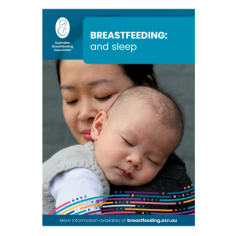
Breastfeeding: and sleep