PMOS (previously PCOS) can cause low milk supply for some women.

Polyendocrine metabolic ovarian syndrome (PMOS) is a common hormonal condition that affects up to 1 in 8 women during their childbearing years (ages 15 to 45).
PMOS was previously known as polycystic ovarian syndrome (PCOS).
PMOS can have wide-ranging health impacts. These may include fertility problems, obesity, excess body hair and acne, metabolic conditions (such as type 2 diabetes), and mental health challenges.
PMOS and milk supply
There hasn’t been a lot of research into how PMOS affects breastfeeding. Some women with PMOS may have problems with low milk supply, but others find they produce enough milk to meet their baby's needs. Low supply is more common in women with PMOS who are also overweight or obese.
Breastfeeding supports metabolic health
Women with PMOS have an increased risk of developing type 2 diabetes (T2D) later in life. Babies born to mothers with PMOS also have an increased genetic risk of type 2 diabetes. Breastfeeding helps to protect mums and babies against T2D and can be an important way to reduce this risk.
How can I prepare for breastfeeding?
There is no way to know if PMOS will affect breastfeeding until you begin, but these simple steps can improve your chances of breastfeeding your baby.
Learn about breastfeeding before your baby arrives.
Plan ahead. Seek help from a lactation consultant or your midwife.
Consider non-medical options for pain relief during labour. Common pain relief drugs can pass to your baby and make them sleepy after birth.
Breast changes
Breasts often change to get ready for breastfeeding. They may feel tender, the areola and nipple may darken, and the bumps around the areola (called Montgomery’s glands) may get bigger. Most women also notice some breast growth by the end of their pregnancy.
If you haven’t noticed any of these changes by late pregnancy you may like to check in with your doctor, midwife or lactation consultant. They can help you to make a plan to get breastfeeding off to a good start.
Getting started with breastfeeding
Once your baby arrives:
Hold your baby skin-to-skin as soon as possible after birth. Most babies will have their first feed within an hour of birth.
Feed your baby whenever they show early signs of hunger. Frequent breastfeeds are important to build up your supply. Most babies will have 8-14 feeds in 24 hours.
If you are separated, or can't breastfeed for any other reason, you can express your colostrum to feed to your baby and build up your supply.
Giving your baby only breastmilk helps to build your supply and protect their health. Avoid giving your baby any formula unless your doctor says you need to. Try to avoid dummies and bottles until breastfeeding is going well.
Low supply
If you have ongoing problems with low supply, your PMOS may be affecting how your breasts make milk.
You may find it helpful to speak to your doctor about medications that can help boost your milk supply.
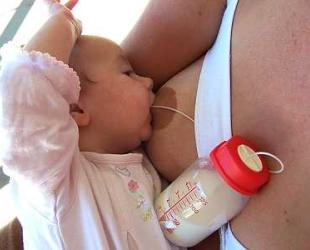
Using a supply line allows your baby to receive extra milk while still feeding at the breast. This tells your breasts to make more milk and gives your baby time to learn how to breastfeed well.
Don't feel disheartened if PMOS means your baby needs to have both breastmilk and formula. This is called mixed feeding and works well for many mums with low supply.
Husby, A. E., Simpson, M. R., Dalbye, R., Løvvik, T. S., & Vanky, E. (2026). Exclusive breastfeeding among women with polycystic ovary syndrome versus women from a population-based cohort: a cohort study. International Breastfeeding Journal, 10.1186/s13006-026-00843-8. Advance online publication. https://doi.org/10.1186/s13006-026-00843-8
Joham, A. E., Nanayakkara, N., Ranasinha, S., Zoungas, S., Boyle, J., Harrison, C. L., Forder, P., Loxton, D., Vanky, E., & Teede, H. J. (2016). Obesity, polycystic ovary syndrome and breastfeeding: An observational study. Acta Obstetricia et Gynecologica Scandinavica, 95(4), 458–466. https://doi.org/10.1111/aogs.12850
Marasco, L., Marmet, C., & Shell, E. (2000). Polycystic ovary syndrome: A connection to insufficient milk supply? Journal of Human Lactation, 16(2), 143–148. https://doi.org/10.1177/089033440001600211
McGuire, E., & Rowan, M. K. (2015). PCOS, breast hypoplasia and low milk supply: A case study. Breastfeeding Review, 23(3), 29–32. https://search.informit.org/doi/10.3316/informit.653946889693518
Rassie, K., Dhungana, R. R., Mousa, A., Teede, H., & Joham, A. E. (2024). Maternal metabolic conditions as predictors of breastfeeding outcomes: Insights from an Australian cohort study. Acta Obstetricia et Gynecologica Scandinavica, 103(8), 1570–1583. https://doi.org/10.1111/aogs.14868
Rassie, K., Mousa, A., Joham, A., & Teede, H. J. (2021). Metabolic conditions including obesity, diabetes, and polycystic ovary syndrome: Implications for breastfeeding and breastmilk composition. Seminars in Reproductive Medicine, 39(3-04), 111–132. https://doi.org/10.1055/s-0041-1732365
Skiba, M. A., Islam, R. M., Bell, R. J., & Davis, S. R. (2018). Understanding variation in prevalence estimates of polycystic ovary syndrome: A systematic review and meta-analysis. Human Reproduction Update, 24(6), 694–709. https://doi.org/10.1093/humupd/dmy022
Teede, H. J., Khomami, M. B., Morman, R., Laven, J. S. E., Joham, A. E., Costello, M. F., Patil, M., Rees, D. A., Berry, L., Cree, M. G., Zhao, H., Norman, R. J., Dokras, A., Piltonen, T., & Global Name Change Consortium (2026). Polyendocrine metabolic ovarian syndrome, the new name for polycystic ovary syndrome: A multistep global consensus process. Lancet, S0140-6736(26)00717-8. Advance online publication. https://doi.org/10.1016/S0140-6736(26)00717-8
Vanky, E., Isaksen, H., Moen, M. H., & Carlsen, S. M. (2008). Breastfeeding in polycystic ovary syndrome. Acta Obstetricia et Gynecologica Scandinavica, 87(5), 531–535. https://doi.org/10.1080/00016340802007676
Vanky, E., Nordskar, J. J., Leithe, H., Hjorth-Hansen, A. K., Martinussen, M., & Carlsen, S. M. (2012). Breast size increment during pregnancy and breastfeeding in mothers with polycystic ovary syndrome: A follow-up study of a randomised controlled trial on metformin versus placebo. BJOG, 119(11), 1403–1409. https://doi.org/10.1111/j.1471-0528.2012.03449.x
Wu, P., Chew-Graham, C. A., Heera-Shergill, N., & Heald, A. H. (2026). Improving awareness and care in polyendocrine metabolic ovarian syndrome (formerly polycystic ovary syndrome). BMJ (Clinical Research Ed.), 393, s893. https://doi.org/10.1136/bmj.s893