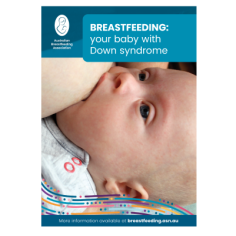
Support, reassurance and practical tips for feeding and early development

Congratulations on the birth of your baby. Things may not be how you expected and you might be feeling a mix of emotions. You’re not alone and support is available as you get to know your baby and learn what works for you both.
If you’ve just found out your baby has Down syndrome, or even if you’ve known for some time, you may be wondering what breastfeeding will be like. Every baby is different. Babies with Down syndrome develop their skills over time and breastfeeding can be part of this early learning and connection.
Why breastfeeding can help
Breastmilk is more than food. It also supports your baby’s comfort, growth and development. For babies with Down syndrome, breastmilk can be especially helpful.
- Breastmilk contains antibodies that help protect your baby from infections. Babies with Down syndrome have a higher risk of infections, especially chest infections.
- Breastfeeding helps strengthen the muscles of your baby’s lips, tongue and face. This helps prepare your baby for eating other foods and for speech development. Breastfeeding gives your baby a chance to use and practise these muscles every day.
- Some babies with Down syndrome are born early. If your baby was premature, colostrum and breastmilk provide important protection and support for growth.
Breastfeeding your baby
Many babies with Down syndrome have low muscle tone. This can affect how they feed, especially in the early weeks.
Your baby may:
- find it hard to get a deep mouthful of breast tissue
- have trouble staying attached
- find it hard to coordinate sucking, swallowing and breathing
- gulp or splutter during feeds
- get tired quickly
- take in less milk during a feed
These early challenges can feel hard, but feeding often improves over time. As your baby grows and breastfeeds, their muscles get stronger and their feeding skills develop.
Holding your baby to breastfeed
Good positioning can help your baby use less energy and feed more comfortably.
Different positions may work for different babies. Some options to try include:
- holding your baby on their side across your lap, facing you, with their lower arm around your body
- using an underarm (football) hold, with your baby tucked beside you, their back supported by your forearm and their head in your hand
No matter what position you use, it will be helpful to:
- support your baby’s whole body so they don’t need to hold themselves up
- keep their chest facing your body, so they don’t need to turn their head to feed
- make sure their head and neck are well supported
- bring your baby up to breast height using pillows, so their mouth is level with your nipple
- place an extra pillow under their bottom to help lift their body and keep them well supported
Some mums use a sling to help keep their baby in a curved ‘C-shape’ with their head and bottom supported.
You can try different positions with various pillows or supports and see what works best for you and your baby.
Helping your baby latch
Many babies need extra help to attach well to the breast.
One technique that can help is the ‘Dancer hand’ hold. This supports both your breast and your baby’s jaw during a feed.
To try the Dancer hand hold:
- cup your hand under your breast
- slide your hand forward so three fingers support your breast
- make a ‘U-shape’ with your thumb and first finger
- use this ‘U-shape to gently support your baby’s jaw while they feed
This can help your baby stay attached and feed more effectively.
Getting your milk flowing
It may help to get your milk flowing before your baby starts to feed. This means your baby doesn’t need to work hard before milk comes.
You could try:
- gently hand expressing a small amount of milk
- rolling your nipple between your thumb and fingers
- stroking your breast down towards the nipple
- holding a warm face cloth to your breast
You could soften the darker area around the nipple (areola) if you need to make it easier for your baby to attach.

Try baby-led attachment
Babies are born with instincts that help them find the breast. Spending time skin-to-skin with your baby can help these instincts work.
You could:
- place your baby on your chest skin-to-skin
- allow them time to move towards the breast
- gently guide and support them as they learn
This is often called baby-led attachment.
Finding information and support
Getting support early can make a big difference. You don’t need to work this out on your own.
- Connect with other parents who have similar experiences
- Contact your state or territory Down syndrome association for local support groups
- Talk with your doctor or child health nurse about services and early intervention programs
- Reach out to an ABA breastfeeding counsellor or lactation consultant for feeding support. They can talk through options with you, such as cup feeding or nipple shields, if needed.
Hearing from other mums
Many parents find it helpful to hear from others who have had a similar experience:
Hear from other mums
Breastfeeding helped with my bonding to James initially when my world was turned upside down by his arrival.
I was encouraged by the Early Intervention Centre to breastfeed because it helps with lip closure and can discourage tongue thrusting as the child gets older.
In the early weeks Tamsyn would make gasping, choky noises during feeds. After some trial and error, a more upright feeding position seemed to minimise this.
The best solution is to talk to other mums with lived experience.
Looking ahead
Things may not be as you expected or hoped for, and feeding your baby may have some challenges, especially in the early weeks.
As your baby grows, they often become stronger and more able to feed. Small changes over time can make feeding easier.
There is support available for you and your family as you care for your baby and help them grow and learn.
You don’t have to do this on your own. Reaching out for support and connecting with others can make a big difference.
Down Syndrome Federation
The Down Syndrome Federation provides a range of supports and services for new parents and families. The national webpage links to all state pages.
Growth charts
Growth Charts for Children with Down syndrome
© Australian Breastfeeding Association June 2026
Find out more about breastfeeding your baby
Evidence-led info and practical tips from our Special Situation Information Series
Breastfeeding: your baby with Down syndrome