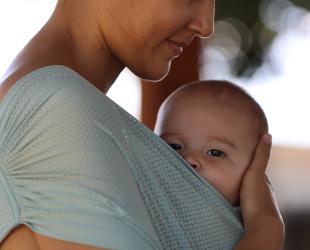
From settling your baby to keeping your hands free, a baby carrier can make everyday life a little easier.

Baby carriers are used by families all over the world. They can be a practical way to keep your baby close while getting on with everyday life.
Whether you're caring for older children, going for a walk, shopping or simply trying to get things done around the house, a carrier can help keep your hands free while your baby stays close and connected to you.
Many parents find that babywearing helps comfort and settle their baby. Being close to a parent and gently moving with them can be calming. A baby carrier can make that easier.
How babywearing can support breastfeeding
Babywearing and breastfeeding often work well together. Keeping your baby close may help you notice the early signs that your baby is ready to feed, making it easier to respond before they become upset.
Some mums choose carriers that allow them to breastfeed while out and about. Others simply enjoy having their baby close between feeds. Every parent and baby pair is different.
Establish breastfeeding first
In the early weeks after birth, both you and your baby are learning how to breastfeed together. Many parents find it easier to try breastfeeding in a carrier once breastfeeding is going smoothly and their baby is attaching and feeding well.
If breastfeeding in a carrier feels difficult at first, it may become easier as your baby grows and develops better head control.
Feeding in a carrier
If you would like to breastfeed while using a carrier, you may need to adjust your baby's position and loosen the carrier slightly so they can reach the breast comfortably. Some carriers are easier to adjust for feeding than others.
You may find it easier if:
- you wear clothing that allows easy access to the breast
- your baby can move their head freely
- you support your baby with your hands during the feed
- you make small adjustments to the carrier rather than large changes.
As with any breastfeeding position, comfort and safety are important for both you and your baby.
After the feed
If you change your baby's position to breastfeed, return them to their normal carrying position afterwards. Your baby should be upright, with their face visible and their airway clear.

Tips for breastfeeding in a carrier
To breastfeed while your baby is in a carrier, you may need to adjust your baby’s position and/or loosen the straps.
- Use a carrier that you can adjust safely and easily while carrying your baby. Carriers that have fabric or straps between you and your baby may be more difficult to feed in.
- Choose clothes (and a bra) that you can easily move out of the way. Lifting a shirt up can be hard when your baby is against your body.
- Loosen the carrier so your baby is lower and in line with your nipple.
- Adjust the carrier so your baby can move their head freely.
- Support your baby with your hands while feeding. Using your arms to take some of their weight can make it more comfortable for you as well as your baby.
- Once your baby has finished feeding move them back into position following the T.I.C.K.S. checklist.
Other safety considerations
As well as positioning your baby safely, there are a few other things to keep in mind when using a carrier.
- Read and follow the manufacturer's instructions for your carrier. Check it regularly for wear and tear.
- Ensure your baby's hips and thighs are well supported. A carrier should allow your baby to sit in a natural position with their legs apart and their knees slightly higher than their bottom.
- Check your baby regularly, particularly in warm weather, and watch for signs that they may be overheating.
- Remove thick or bulky clothing before putting your baby in the carrier. Instead, use layers that can be added or removed as needed.
- Take extra care on stairs or uneven ground, as carrying your baby may affect your balance and movement.
- Avoid activities that could expose your baby to heat, chemicals or a risk of falls.
What if my baby falls sleeps in the carrier?
Many babies fall asleep while being carried. Newborn babies, in particular, may spend much of their time sleeping in a carrier.
The most important things are to make sure your baby can breathe easily and that they are not overheating. Check that your baby's position remains safe and that their face stays uncovered. Young babies may not have the strength to keep their head upright if they slip down in the carrier, so it's important to check them regularly.
Your baby should always be close enough for you to monitor them, and you should be awake and alert while using the carrier.
Getting support
Learning to use a carrier comfortably and safely can take practice. If you're unsure about positioning, fit or using a particular carrier, a trained babywearing educator or consultant may be able to help.
If you need support with breastfeeding, talk with a counsellor on the National Breastfeeding Helpline.
Further reading
Australian Babywearing Association
ACCC Safety Guide: Baby carriers, wraps and slings guide
The T.I.C.K.S. Rule for Safe Babywearing | UK Sling Consortium
Baby Carriers & Other Equipment | International Hip Dysplasia Institute
Slings and baby carriers | Red Nose Australia
© Australian Breastfeeding Association July 2026