Expressing made simple: how much, how long, and how often to pump for your baby.
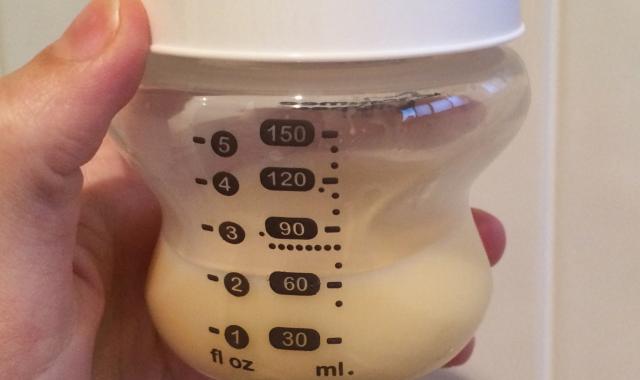
Expressing breastmilk is something many mums consider, whether it’s for returning to work, building up a supply, or simply having milk ready when needed.
There’s no single right way to approach it. What matters most is finding what works for you and your baby.
Ways to express breastmilk
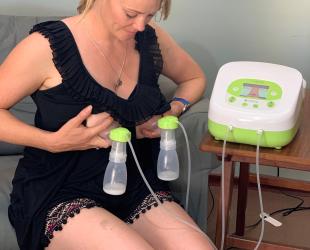
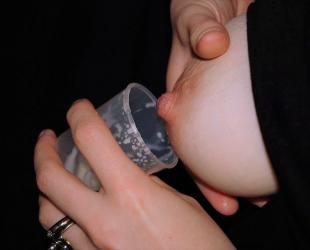
You can express milk by hand, with a manual pump, or with an electric pump. Your choice may depend on your situation and how much milk you need:
- Electric breast pumps are often helpful if you’re expressing for a premature baby, planning to return to work, or trying to increase your milk supply. These situations usually need frequent expressing to collect larger amounts of milk.
- Manual pumps or hand expressing can be enough if you only need small amounts or want to have milk available for occasional feeds.
How much milk do I need to express?
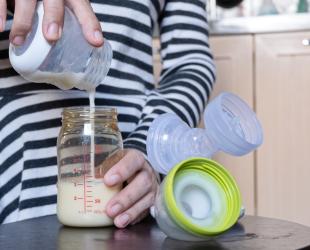
If you’re expressing for all your baby’s feeds, you’ll need to pump more than if you’re just covering the occasional feed. Research shows that breastfed babies aged 1 to 6 months take an average of 750 mL per day, but some need less and some more.1,2
To estimate how much to express:
- Divide 750 mL by the number of feeds your baby usually has in 24 hours to get the volume for one feed.
- Multiply this by the number of feeds you’ll be away for.
Example: If your baby has 10 feeds in 24 hours, 750 mL ÷ 10 = 75 mL per feed.
If you’ll miss 3 feeds, aim to leave 3 lots x 75 mL which is 225 mL.
If your baby is 6 to 12 months, they'll be having some solids and so may need less milk. The average breastmilk intake in this age range is around 600mL per day.3
How often should I express?
How often you need to express depends on your situation:
- If you’re exclusively expressing, aim for at least 8 times in 24 hours.
- Many mums find a routine of expressing every 2 to 3 hours during the day, with a session before bed, works well.
- Try to avoid long gaps (over 6 hours) between sessions if you’re building up supply.4 This may mean expressing once or twice at night.
- Every mum is different, so you may need to experiment to find a pattern that suits you.
How long does expressing take?
- The time it takes to express varies. It depends on the time of day, your technique, the type of pump and setting, and your milk flow.
- Most pumping sessions last about 15 to 20 minutes, or until milk slows to a drip. Some mums need a little more time, some less. How often you express is usually more important than how long each session takes.
- It can take a minute or two for milk to start flowing. Seeing, touching, or hearing your baby can help trigger your let-down reflex.
- Try to keep going for a few minutes after milk stops flowing, as this might trigger another let-down.
- For most mums, pumping for more than 30 minutes is too long.
Helping your milk to flow
Many mums find they only express a small amount. This doesn’t mean you don’t have enough milk—often, it’s just that your let-down reflex hasn’t kicked in yet. The let-down is a natural response that usually happens when your baby starts sucking, but when you’re expressing, you might need a little extra help to get things flowing. The good news is there are plenty of simple ways you can encourage your let-down.
- Relax in a way that suits you: Try to pump in a quiet, warm, relaxing space, away from distractions. Breathe slowly and deeply. Express in the spot you usually feed. Some mums enjoy a warm drink or soft music first.
- Use warmth and gentle massage: Express after a warm shower or place a warm washer on your breast for a few minutes. Stroke down from your chest towards your nipple or gently draw your nipple out between your fingers. Touching your breasts and nipples can help trigger the let-down.
- Think about your baby: If you’re away from your baby, looking at a photo or video can help. A blanket from your baby’s cot may help too—the smell reminds you of your baby. If your baby is in hospital, you might find it easier to pump near their cot or just after leaving them.
- Distract yourself: Watch a video, read, or talk on the phone. This can help you stop worrying about how much milk you’re expressing. Some mums cover the pump with a cloth so they don’t keep checking it. Being relaxed is key.
- Have someone to support you: Many mums find it easier with an encouraging partner or friend nearby.
What if I can’t express much?
- Some mums can express a lot quickly, while others find it easier to express small amounts more often (e.g., up to 30 mL every 1 to 2 hours).
- Don’t judge your milk supply by how much you can express. Pumping and hand expressing are skills that can take time to learn. Babies are usually better at getting milk than pumps.
Is expressing the best option for me?
Here are some things to consider:
- Expressing isn’t always needed. Many mums never need to express and find breastfeeding fits their lives.
- It takes time and energy. Using a pump means extra time for setup and cleaning, along with the time taken to feed the expressed milk to your baby.
- It can increase supply unnecessarily. Expressing more than your baby needs can lead to oversupply and breast inflammation.
- It takes practice. Some mums find expressing difficult, even with a good supply.
- It may not fix breastfeeding problems. If breastfeeding isn’t going well, getting support may be a better long-term fix.
Whether you’re expressing or not, you can always talk to an ABA breastfeeding counsellor for support and to make a plan that works for you.
© Australian Breastfeeding Association November 2025
Rios-Leyvraz, M., & Yao, Q. (2023). The volume of breast milk intake in infants and young children: A systematic review and meta-analysis. Breastfeeding Medicine, 18(3), 188–197. https://doi.org/10.1089/bfm.2022.0281
Kent, J. C., Mitoulas, L. R., Cregan, M. D., Ramsay, D. T., Doherty, D. A., & Hartmann, P. E. (2006). Volume and frequency of breastfeedings and fat content of breast milk throughout the day. Pediatrics, 117(3), e387–e395. https://doi.org/10.1542/peds.2005-1417
National Health and Medical Research Council (NHMRC). (2013). Australian Dietary Guidelines Summary. Canberra: National Health and Medical Research Council. Retrieved from https://www.eatforhealth.gov.au/sites/default/files/2022-09/n55a_austra…
Lai, C. T., Rea, A., Mitoulas, L. R., Kent, J. C., Simmer, K., Hartmann, P. E., & Geddes, D. (2020). Short-term rate of milk synthesis and expression interval of preterm mothers. Archives of Disease in Childhood. Fetal and Neonatal Edition, 105(3), 266–269. https://pubmed.ncbi.nlm.nih.gov/31296697
Read more about expressing and storing
Evidence-led info and practical tips from our Breastfeeding Information Series