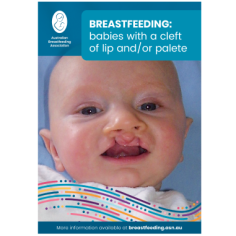
Feeding your baby may look different, but there are ways to make it work.
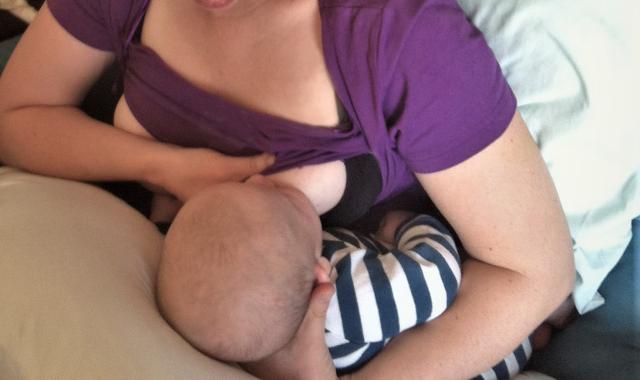
You may have many thoughts and feelings if you’ve learned your baby has a cleft of the lip and/or palate. You're probably wondering how feeding will work.
Some babies are able to breastfeed from birth. Others learn over time, with extra support and different techniques. You and your baby can learn together.
If breastfeeding isn’t possible at first, you can still feed your baby your own breastmilk. Hospital staff can usually help you express milk.
After you go home, you could consider getting a referral to a lactation consultant for support with breastfeeding.
Why breastmilk is especially important for babies with a cleft
Breastmilk helps protect your baby from infection. Babies with a cleft palate are more likely to have ear infections. This is because milk can move into the tubes that connect the throat and ears.1 Ear infections can affect hearing and, over time, speech and language development. Breastmilk contains immune factors that help reduce the risk of these problems and support your baby’s longer-term health.
Breastfeeding also supports your baby’s facial and jaw development. Feeding at the breast uses a coordinated sucking action that helps strengthen the muscles of your baby’s face as they grow.2
Breastmilk can support healing after surgery. It contains protective and healing factors that help reduce the risk of infection and support your baby’s recovery.3 Many babies are able to breastfeed or receive breastmilk soon after surgery. Your health team will let you know what is safe and comfortable for your baby. Breastfeeding is comforting for your baby and your soft nipple will not hurt or damage their mouth.
Breastfeeding also helps you and your baby feel close and connected. Skin-to-skin contact and time together help you get to know each other.
How clefts can affect breastfeeding
A cleft can affect the lip, the roof of the mouth (palate), or both. The way it affects feeding depends on which parts are involved.
Every baby feeds differently. It may take time to find what works best for you and your baby.
Cleft of the lip
Many babies with a cleft of the lip can breastfeed. You may find small adjustments make a difference, for example:
- You could gently use a finger to close the gap and help your baby to get better suction.
- Hold your baby so your breast tissue can help fill the gap and improve the seal.
Cleft palate
A cleft palate affects the roof of your baby’s mouth. This makes it harder for your baby to create suction during feeding.
Some babies may look like they are feeding well. They may attach to the breast or teat and seem to suck strongly. However, they may not be able to draw milk effectively.
Your baby may need more time to feed, may tire more easily or may not get as much milk as expected.
You might also notice sounds such as clicking, or your baby slipping on and off during feeds.
Clefts of the palate can vary. Some affect only the soft palate at the back of the mouth, while others involve both the soft and hard palate. These differences can affect how easily your baby feeds, but support is available.
Cleft lip and palate
When both the lip and palate are affected, feeding can be more complex. Your baby may find it harder to:
- form a seal around the breast
- create enough suction
- move milk effectively
Feeds may take longer and use more energy.
Some babies learn to breastfeed with time and support. Others may need a combination of breastfeeding, expressed breastmilk and other feeding methods.
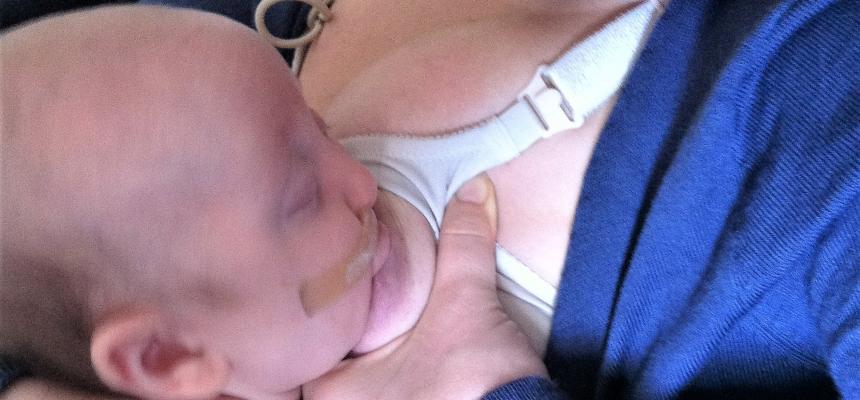
Breastfeeding your baby
Even when feeding is more challenging, there are still ways to help your baby feed and get your breastmilk.
Some babies are able to breastfeed from birth. Others learn over time, with support and different approaches. You and your baby can learn together.
All babies have a natural urge to suck after birth. Your breast is soft and can help fill the gap in your baby’s mouth as they learn to feed.
Some babies get most of their milk at the breast. Others may need a mix of breastfeeding and expressed breastmilk or other feeding methods.
What you can try
You may find it helps to:
- keep your baby’s head close to your breast during feeds
- use breast compressions to help milk flow
- support your breast to help maintain a seal
- allow time for comfort sucking and feeding to sleep
Any time your baby spends at the breast is helpful. It gives your baby a chance to practise and can support their muscle development.
Taking it step by step
Feeding a baby with a cleft can take time and patience. Some feeds may be longer or more tiring, especially in the early weeks.
It’s okay if things don’t work straight away. Many babies become more effective at feeding as they grow and develop.
Taking things one day at a time and adapting as your baby’s needs change can help.
Expressing and maintaining your milk supply
If your baby isn’t yet able to get enough milk at the breast, expressing can help you build and maintain your supply.
Most mothers are able to make enough milk for their baby. The more often milk is removed, the more milk your body will make. Your baby's milk needs don’t increase much from 1 to 6 months of age.4 This means you won’t need to keep increasing the amount of expressed milk as your baby grows bigger. However, you may find your baby needs extra milk after surgery, as they recover.
You may find it helps to:
- express as often as your baby would feed. For newborns this is typically more than 8 times in 24 hours
- include some expressing during the night in the early weeks
- use a hospital grade or double electric pump. ABA Virtual Village members receive a 50% discount on breast pump hire costs.
Encouraging your let-down reflex can help your milk flow more easily. Even small amounts of breastmilk are valuable for your baby.
Wind and regurgitation
Many babies with a cleft swallow more air during feeds. This can lead to wind, discomfort or unsettled behaviour. It can happen whether they’re breastfed, bottle-fed with expressed breastmilk fed with formula.
These ideas may help:
- feeding your baby in a more upright position
- pausing to burp your baby during feed
- holding your baby upright after feeds
- gentle massage
Some babies bring milk out through their nose. This can happen because of the cleft and will stop after the palate is repaired. Breastmilk will not harm the lining of your baby’s nose.
Bottles, teats and other feeding equipment
Some babies need extra help to feed well. There are a range of bottles, teats and feeding tools designed for babies with clefts.
You may need to try a few options to find what works best for your baby.
There are different types of bottles designed to help babies with a cleft feed.
Many are designed to help milk flow without your baby needing to create strong suction.
Squeeze bottles (you control the flow)
These have soft sides so you can gently squeeze to match your baby’s feeding rhythm. Examples include:
- Pigeon cleft palate bottle
- Softplas squeeze bottle (Douglas Bean, Australia)
- CleftPALS Queensland squeeze bottle
Specialised valve feeders (baby compresses the teat)
These use valves and specially designed teats to allow milk to flow without suction. Examples include:
- Medela SpecialNeeds Feeder
- Dr Brown’s Specialty Feeding System
Whichever feeding method you use, it can help if milk doesn’t flow too quickly. Babies are still learning to suck, swallow and breathe in a coordinated way. If milk flows too fast, your baby may cough, gag or bring milk back up.
'Working' for the milk will also help your baby develop their facial muscles and a strong sucking response.
Teats are an important part of how your baby feeds. The right teat can help your baby manage the flow of milk more easily.
With squeeze bottles, you control the flow of milk by gently squeezing the bottle. The teat helps your baby take in the milk and needs to suit their ability.
With specialised feeders (such as the SpecialNeeds or Dr Brown’s), the teat and valve system work together. Your baby feeds by pressing or compressing the teat, rather than needing to suck.
Some teats are designed to work with specific bottles. Others can be used in different combinations.
You may come across:
- Pigeon Cleft palate teat
- Chu Chu Easy Feed teat
You may need to try a few options to find what works best for your baby.
Some babies need extra support to feed, especially while they are learning or if breastfeeding is not yet working well.
There are a few other ways to give your baby milk. These can be used on their own or alongside breastfeeding and expressing.
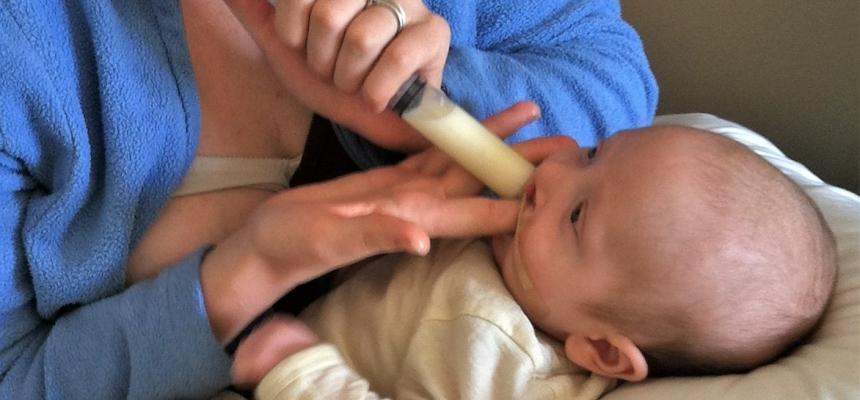
- Syringe feeding - often used when most feeds are done at the breast.
- Spoon feeding - can be slow at first, but with practice it can speed up.
- Supply line – your baby can receive extra milk while feeding at the breast.
- Nipple shields - when baby is struggling to attach or has got used to a bottle teat.
- Cups e.g. Medela SoftCup feeder
Hear from other mums
Kathryn had a cleft of the soft palate and slightly into the hard palate. I was unable to breastfeed her as she could not make enough suction to milk the breast. I expressed for 12 months. Kathryn was exclusively breastmilk-fed for 7 months, then continued to have breastmilk along with other food until 12 months of age. She was a healthy baby and is a very active, healthy toddler. I found expressing the milk was the easy part, but feeding it to her was hard.
We started with a squeezy bottle and a normal teat. We went through over 15 different types of teats but she still couldn't feed properly. We eventually used a Haberman Feeder. It cut feeding times down from 90 minutes to 20–30 minutes. When I wanted to increase my supply I would express more often and I would start to see an increase by day 4. Expressing for my daughter was very rewarding. Sometimes I felt like it was the one positive thing I could do for her. It was particularly good for both of us after her surgery. She had a very fast recovery with no infections and did not need much pain relief.
Rebecca had a cleft of the soft and hard palate diagnosed on day three. I was unaware of assisted breastfeeding techniques and as she had a collapsed lung at birth she struggled to take fifty percent of her bottle, so for the first three months we also used a nasal gastric tube to compliment her feeds until we could see a cleft specialist at three months of age. Weaning her off the nasal gastric tube was challenging and ended up requiring short term medication to stimulate her appetite.
At first we used a Haberman feeder, then we trialled the squeeze bottle with the Chu Chu teat and pigeon valve. During this time I expressed four to six times a day with ten minute pumping sessions, the frequency of sessions reflected the number of feeds a normal breastfed baby may have. I was able to keep a strong supply going with the aid of a toddler who was still breastfeeding and some medication.
At nine months she had her surgery, which was successful. Determined not to give her another bottle and to get her on the breast, I spoon fed her liquid and purees the first four weeks, we then used a supply line and nipple shield for the next five weeks until one evening she proved that could breastfeed unassisted. All up I expressed for my daughter for eleven months. At thirteen months of age the breastfeeding is still going well and it is such a joy, and such a delight and time saver no longer having to pump.
Support for you and your baby
You don’t have to manage this on your own. Support is available from:
- your child health nurse
- a lactation consultant
- an ABA breastfeeding counsellor
They can help you find feeding approaches that suit you and your baby. They may also be able to connect you with other families who have had similar experiences.
CleftPALS (Cleft Palate and Lip Society)
CleftPALS is a support organisation in each state. It consists of professionals and parents involved in the treatment of the cleft condition. Volunteers from CleftPALS offer support and guidance to new families all over Australia.
(NSW) CleftPALS NSW www.cleftpalsnsw.org.au
(QLD) CleftPALS Queensland www.cleftpalsqld.org.au
(VIC) CleftPALS Victoria https://www.cleftpalsvic.com/
(WA) CleftPALS WA https://www.cleftpalswa.org.au/
The Royal Children’s Hospital Melbourne Cleft lip and palate – infant feeding
Cleft Connect Australia https://cleftconnect.org.au
© Australian Breastfeeding Association June 2026
Aniansson, G., Svensson H., Becker, M., Ingvarsson, L. 2002, Otitis media and feeding with breast milk of children with cleft palate. Scand J Plast Reconstr Surg Hand Surg 36(1):9–15. https://doi.org/10.1080/028443102753478318
Piston H, Jabbour N, Ford MD, Goldstein JA, Losee JE, Shaffer AD. The Impact of Human Milk on Tympanostomy Tube, Hearing, and Speech Sequelae in Children With Cleft Palate. Cleft Palate Craniofac J. 2025 Oct 3:10556656251380545. https://doi.org/10.1177/10556656251380545
- Azanza Santacruz, C.M., Freire Narváez, J.E., Lema Mosquera, V.R., León Abad, M.C., Luzuriaga Torres, Y.C., Montero Pasato, M.P., and Yunga Picón, M.Y. 2023, Efficacy of breastfeeding in Dentomaxillofacial development: Narrative review of the literature. World Journal of Advanced Research and Reviews, 2023, 19(1), 446-454. https://doi.org/10.30574/wjarr.2023.19.1.1351
- Szyller, H., Antosz, K., Batko, J., Mytych, A., Dziedziak, M., Wrześniewska, M., Braksator, J., & Pytrus, T. (2024). Bioactive Components of Human Milk and Their Impact on Child’s Health and Development, Literature Review. Nutrients, 16(10), 1487. https://doi.org/10.3390/nu16101487
- Kent, J.C., Leon, M.R., Cregan, M.D., Ramsay, D.T., Doherty, D.A., Hartmann, P.E. 2006, Volume and frequency of breastfeeding and fat content of breastmilk throughout the day. Pediatrics 117(3):e387–e395. https://doi.org/10.1542/peds.2005-1417
Read more about breastfeeding your baby
ABA booklets - for evidence-led info and practical tips
Breastfeeding: your baby with cleft of lip and/ or palate