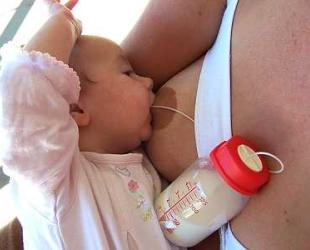
Some breasts need a little help. Here’s how you can still breastfeed your baby if you have IGT.

Most mums make enough milk for their babies but some aren't able to produce enough. One reason can be something called insufficient glandular tissue (IGT) also known as breast hypoplasia.
Glandular tissue is the part of the breast that makes milk. Hypoplastic breasts don’t have enough of this glandular tissue. It’s not necessarily the size of breasts that’s important but their shape, placement and symmetry.
Signs that may suggest IGT
You might have IGT if you have several of the following:
- Breasts that are widely spaced (more than 4cm apart)
- One breast that is much larger than the other
- Tubular-shaped breasts (with a narrow base and a long shape)
- Very large or bulbous areolae (as if attached onto the breast)
- You didn't have any breast changes during pregnancy, after birth or both.
Some mums who have one or more of these signs go on to make a full milk supply for their baby. Others find that, even with information and support, they aren't able to produce the full amount of breastmilk their baby needs.
Practical steps for breastfeeding with IGT
If you know before you have your baby, the following ideas will maximise your potential to breastfeed successfully.
- Make a plan with an ABA counsellor or a lactation consultant during your pregnancy
- Attend an ABA Breastfeeding Education Class or livestream Breastfeeding Preparation Session to ensure you're well-prepared for breastfeeding.
- Consider expressing colostrum from 36 weeks into your pregnancy.
- Start your breastfeeding journey with immediate skin-to-skin contact with your baby and offer frequent breastfeeds.
- Explore options like syringe or cup feeding and donor milk.
- Ask your doctor about pharmaceutical galactagogues in the very early days to help you produce more milk.
If you find out after you've been breastfeeding for a while:
- Have continuous skin-to-skin time and breastfeed frequently.
- Monitor the signs that show your baby is getting enough milk.
- Talk to a lactation consultant or a breastfeeding medicine doctor about your ongoing feeding options.
Supplementing if needed
You may find that even though you’ve tried everything, your baby will need to be supplemented. You could consider obtaining donor breastmilk.
The amount you supplement will depend on how much milk you make. You can give this extra milk using a bottle (consider paced bottle feeding), a cup or a supply line (which lets baby get other milk as they suck at the breast).
Making peace with your breastfeeding journey
Coming to terms with not being able to fully breastfeed can take time. It’s okay to feel a range of emotions about your experience and to give yourself time to grieve the breastfeeding journey you imagined.
Try talking with other mums, learning about what newborns usually do, and getting help from a ABA breastfeeding counsellor or lactation consultant. Share what matters most to you, so you can make a feeding plan that works for you and your baby. With support, many mums achieve their goals and have a fulfilling breastfeeding relationship.
Breastfeeding is so much more than the amount of milk you are able to make. It’s a relationship with your baby. But also know that all the breastfeeding you do contributes to positive lifelong health benefits for both you and your baby.
Further reading
Scott, S. F., Searcy, J., & Jordan, I. (2025). 'Why is there not a doctor that knows anything about this part of my body?” Patient Perspectives on Chronic Lactation Insufficiency. Breastfeeding Medicine. https://doi.org/10.1089/bfm.2025.0018
© Australian Breastfeeding Association February 2026